


300+ Free Classified Submission Sites (Updated List) for SEO & Local Marketing 300+ Free Classified Submission Sites Updated List + Classified Posting & SEO Roadmap A practical publisher-friendly resource for discovering classified platforms that may support online visibility, local discovery, referral traffic and diversified marketing efforts. Best SEO Title 300+ Free Classified Submission Sites (Updated List) for SEO, Traffic & Local Business Promotion Introduction Classified submission can be a useful supporting channel for businesses, freelancers, publishers and service providers. The strongest approach is not to publish the same advertisement everywhere. Instead, choose relevant platforms, create useful listings, follow each site’s rules and measure whether the listings generate meaningful visits or leads. This guide contains the complete classified-site list supplied for this article, including the source-provided DA and PA figures, followed by a practical roadmap for planning and managing submissions. Publisher note: The directory below reproduces the supplied source data. Website status, registration requirements, moderation, fees, posting rules and link attributes can change. DA and PA are third-party metrics and do not guarantee traffic, rankings or backlink value. Why Use Classified Submission Sites? Referral TrafficUseful listings can introduce your website to people already browsing relevant offers. Local VisibilityLocation-focused classified platforms can complement local marketing efforts. Brand DiscoveryListings can expand where customers encounter your business or project online. Link OpportunitiesSome platforms allow website links, although link attributes differ by site. Low-Cost PromotionMany classified platforms provide free posting options, subject to their rules. Fast PublishingSome sites can make listings visible quickly after submission or moderation. Classified Submission Roadmap Define your objective. Choose one primary goal: local leads, product inquiries, service requests, referral traffic or brand awareness. Build a relevant shortlist. Start with platforms that fit your niche, audience and geographic market. Prepare your landing page. Send visitors to the most relevant page instead of automatically using the homepage. Create your listing assets. Prepare a concise headline, helpful description, location, contact details, image and call-to-action. Personalize each submission. Adapt wording to the platform and audience. Avoid mass-produced spam. Follow posting rules. Respect category requirements, verification, posting limits and prohibited-content policies. Track performance. Monitor visits, inquiries and conversions with analytics or campaign tracking where appropriate. Keep winning listings fresh. Update or repost only when permitted and when there is a genuine marketing reason. Review monthly. Check for expired listings, broken links, outdated business information and low-value platforms. How to Post a Classified Ad 1. Pick the right platform Match the site to your industry, location and audience. Relevance is more important than submitting to every available domain. 2. Create an account Where registration is required, use accurate business information and complete verification. 3. Choose the correct category Use the most specific category available so the listing reaches people looking for that type of offer. 4. Write a clear title State the offer and, when useful, include a relevant service or location keyword without keyword stuffing. 5. Write useful description Explain what you offer, who it is for, the main benefit, location or service area and what the visitor should do next. 6. Add your website when allowed Use a relevant destination URL and follow the site’s link rules. 7. Add an accurate image Use a clean image that genuinely represents the product, service or opportunity. 8. Verify and monitor Confirm publication, check the live page and track results rather than measuring success by submission count alone. SEO Best Practices Prioritize quality and relevance over submission volume. Use human-written, useful listing copy. Keep business details accurate and consistent. Do not assume every classified link is dofollow. Do not use automated spam or deceptive listings. Use analytics to measure actual traffic and conversions. Remove or update outdated listings where the platform permits it. Complete Classified Submission Sites List All numbered entries below are taken from the supplied list. Entries with unusual or malformed domain/path text are retained as supplied rather than silently corrected. All DADA 50+DA 30–49DA under 30 NumberDA high → lowPA high → lowSite A → Z Reset No. Classified Site DA PA URL ← PreviousNext → Featured India Platforms Mentioned in the Source The supplied article highlights OLX.in, Quikr.com, ClickIndia.com, Locanto.in, Sulekha.com, Adpost.com, PostFreeAds.in, FreeAdsTime.org, FinderMaster.com and WallClassifieds.com for India. Featured USA Platforms Mentioned in the Source The supplied article highlights Craigslist.org, Oodle.com, USFreeAds.ws, ClassifiedAds.com, Hoobly.com, OfferUp.com, Geebo.com, FreeAdsTime.org and PennySaverUSA.com for the USA. Frequently Asked Questions Should I submit to all 300+ sites? No. Start with relevant, active platforms and expand based on performance and audience fit. Do classified links improve rankings automatically? No. A listing or backlink is not a guaranteed ranking boost. Search value varies by platform, link attributes, relevance and overall quality. Are all sites free? The source describes this as a free classified-site list, but individual platforms can change their pricing, categories or posting requirements. Check the current site before posting. How often should I repost? Follow the platform’s rules and repost only when it provides genuine value. Avoid repetitive or excessive posting. Can classified submissions replace SEO? No. They should be treated as one supporting marketing channel alongside useful content, technical SEO, local SEO and other legitimate promotion methods. Publisher resource based on the supplied Citation Forge material. Verify live websites and current metrics before publication.
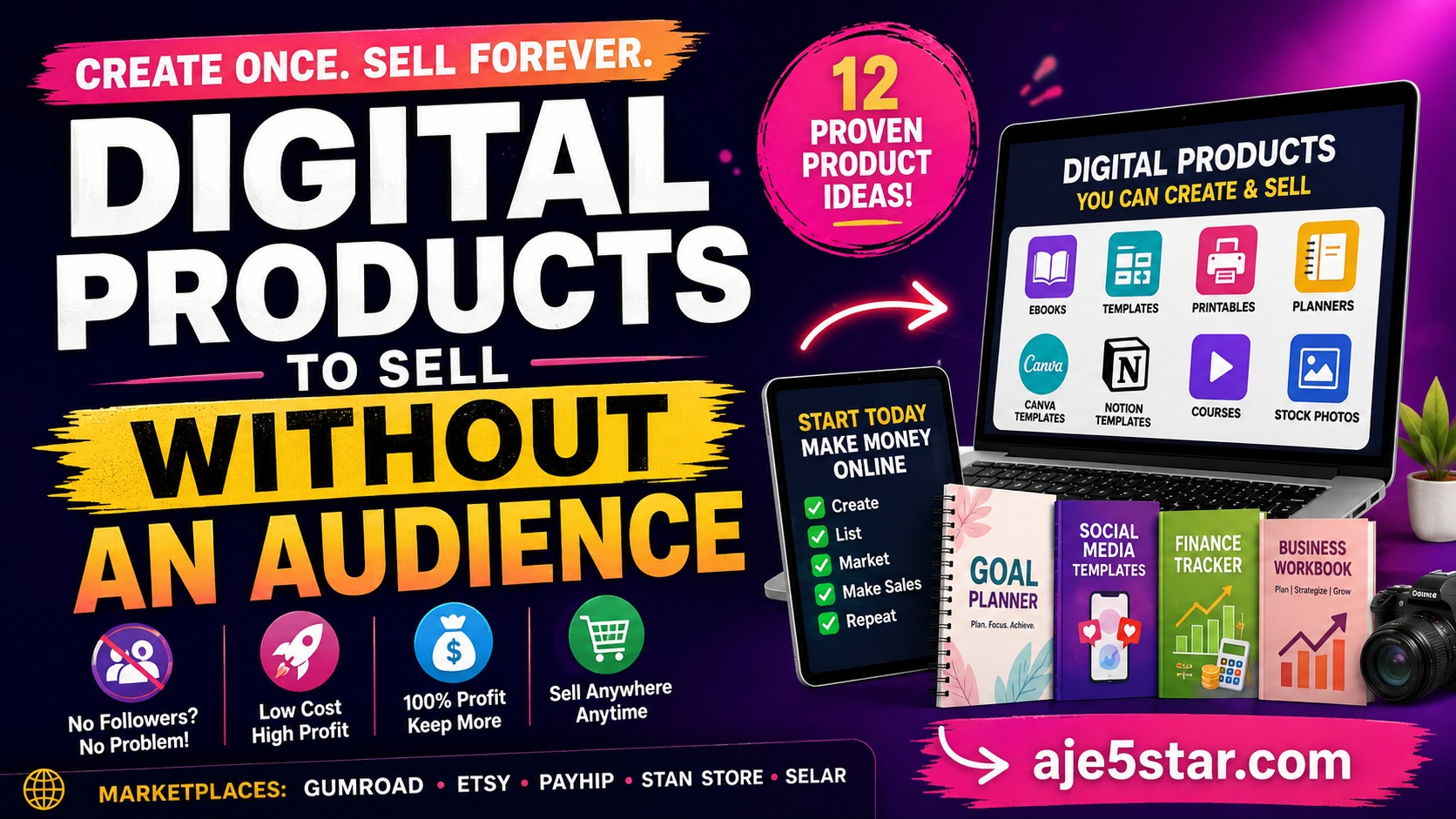
Digital products to sell without an audience
AJE5STAR • DIGITAL BUSINESS GUIDE 12 Digital Products You Can Sell Without an Audience A practical beginner-friendly guide to creating, listing, marketing, and selling digital products even when you have zero followers. aje5star.com Publisher’s Note: “Zero audience” should not be interpreted as “zero marketing.” A new creator can start without followers, but every product still needs a way to be discovered. Marketplaces, search engines, Pinterest, social platforms, communities, partnerships, and useful content can all help create that discovery. You do not need 100,000 followers to start selling a digital product. You do not need to be famous. You do not need to become an influencer. And you certainly do not need to wait until thousands of people are following you before you create something valuable. What you do need is a useful product that solves a specific problem, a clear description of the result your customer wants, a place where people can purchase it, and a strategy for getting that product in front of the right people. That is the real lesson behind the infographic featured with this article: you can build a digital-product business before you build a large audience. The internet has created a huge market for downloadable resources, templates, educational materials, graphics, guides, software assets, printables, courses, and other forms of digital content. The opportunity is not simply to “make something and hope somebody buys it.” The opportunity is to identify a problem, create a useful solution, package it professionally, and place it where potential customers can find it. 📚 Table of Contents Why You Don’t Need a Huge Audience to Start One of the biggest misconceptions about digital products is that you must already have an audience before you can make your first sale. An audience can certainly help. A creator with a large email list or social following may have an easier time launching a product because they already have people paying attention. But an audience is not the only source of customers. ❌ The Myth “I need thousands of followers before I can sell anything.” ✅ The Reality You need a useful product, the right marketplace or sales page, discoverability, and a consistent way to reach potential buyers. For example, a person searching for a specific printable on a marketplace may never have heard of the creator before. They do not need to become a follower first. They simply need to discover the product and decide that it solves their problem. 12 Digital Products You Can Sell The following ideas are based on the categories shown in the infographic. Each one can be developed into a legitimate digital business, although the demand, competition, pricing, and legal requirements will vary by niche. 1 PLR Products Properly licensed private-label-rights content can sometimes be adapted and resold according to the license terms. Always verify exactly what rights you purchased. 2 Canva Templates Create editable templates for social media, presentations, resumes, planners, marketing materials, and other legitimate use cases while following the platform’s licensing rules. 3 Printables Printables can include planners, worksheets, checklists, trackers, classroom resources, wall art, and organizational tools. 4 Stock Photos Original photography can be packaged into themed collections for bloggers, designers, marketers, businesses, and creators. 5 Fonts & Graphics Original fonts, icons, illustrations, SVG assets, patterns, and design resources can serve other creators and businesses. 6 Notion Templates Productivity dashboards, project systems, content planners, personal organizers, and business workspaces can become useful digital products. 7 Ebooks & Guides Package your knowledge into a structured guide that helps readers accomplish a specific goal. 8 Worksheets & Trackers Budget sheets, habit trackers, project worksheets, goal planners, and business checklists can solve very specific problems. 9 Digital Wallpapers Original wallpapers can be created for phones, tablets, computers, and other digital devices. 10 Pre-Recorded Courses A course can package a repeatable learning experience into videos, worksheets, exercises, and downloadable resources. 11 Website Templates Developers and designers can create legitimate website templates for WordPress, HTML, Shopify, Framer, and other supported platforms. 12 Audio & Sound Effects Original music loops, sound effects, meditation audio, podcast assets, and other properly licensed audio resources can be packaged for creators. Which Digital Product Should You Start With? If you are a beginner, don’t automatically choose the product that looks like it could make the most money. Choose the product that you can create well and improve over time. Product Good For Difficulty Printables Organizers, planners, educators Beginner Templates Designers, marketers, businesses Beginner–Intermediate Ebooks Writers, educators, specialists Beginner Stock Photos Photographers and visual creators Intermediate Notion Templates Productivity and business creators Intermediate Courses Teachers and experienced professionals Intermediate–Advanced Website Templates Developers and designers Intermediate–Advanced Where Can You Sell Digital Products? You don’t necessarily need to build a complicated ecommerce website before you make your first product. Digital-product platforms can provide storefront and checkout infrastructure, depending on the service and product type. 🟣 Gumroad gumroad.com A creator-focused platform for selling digital products, memberships, courses, and other digital offerings. Visit official website → 🟠 Etsy etsy.com A large marketplace where creative sellers can list products and reach shoppers already searching for items. Visit official website → 🔵 Payhip payhip.com A platform designed for selling digital downloads, courses, memberships, coaching and other products. Visit official website → 🟣 Stan Store stan.store A creator storefront option that can be useful for creators selling digital offers through their online presence. Visit official website → 🟡 Selar selar.co A digital-commerce platform used by creators and businesses for selling online products and services. Visit official website → The Marketplace Advantage A marketplace can be useful when you have no audience because customers may already be searching there. That does not mean simply uploading a product guarantees sales. Competition can be intense, and your listing still needs a strong title, useful description, attractive preview images, appropriate keywords, and a product that actually satisfies the buyer. Think of the marketplace as a store location. Your product is the merchandise. Your title and images are the storefront. Your description explains the value. Your

Free traffic sources for digital products
AJ E5STAR.COM • DIGITAL BUSINESS GUIDE 14 Free Traffic Sources for Digital Products How to get more leads, build an audience, and make more sales without depending entirely on paid advertising. 📈 Organic Traffic 🎯 Lead Generation 📧 Email Marketing 🚀 Digital Products 🔎 SEO Creating a digital product is only half of the business. The other half is getting the right people to discover it. You can create a beautiful ebook, planner, checklist, workbook, template bundle, mini-course, prompt pack, or another digital product, but if nobody knows it exists, making sales becomes much harder. That’s why traffic matters. The good news is that you don’t necessarily need a huge advertising budget to start promoting a digital product. There are many places where creators can publish useful content, build an audience, attract visitors, collect leads, and introduce potential customers to their products. Important: “Free traffic” does not mean that building an audience requires absolutely no investment. Organic traffic normally requires time, research, content creation, testing, and consistency. It also does not guarantee sales. 📚 Table of Contents Why Free Traffic Matters Pinterest Instagram YouTube TikTok Email Marketing Online Communities Blogging & SEO Quora Medium LinkedIn X Podcasts Threads Freebie Collaborations Content Repurposing Lead Magnets Free-Traffic Funnel 30-Day Plan FAQ Why Free Traffic Is Important for Digital Products Digital products have an interesting advantage over many physical products. Once a product has been created, it can often be delivered digitally without manufacturing a new physical item for every buyer. You could create products such as: 📘 Ebooks 📅 Printable planners ✅ Business checklists 📄 Resume templates 🎨 Canva template packs 📝 Workbooks 📊 Spreadsheets 🤖 AI prompt collections 📔 Digital journals 💡 Educational guides But creating the product isn’t enough. You also need a distribution strategy. The Simple Digital Product Formula Content → Traffic → Trust → Leads → Customers Copy Formula 1 Pinterest Visit Pinterest Business → Pinterest can be especially useful for visual digital products such as planners, printables, templates, checklists, worksheets, journals, and educational resources. How to use Pinterest Instead of creating a Pin that simply says “Buy my ebook,” create something useful that solves a small problem. For example: “10 Things Every New Online Business Owner Should Do This Week.” Link the Pin to a detailed article on your website and introduce your related product naturally. Simple path: Pinterest → Blog → Free Resource → Email → Product 2 Instagram Visit Instagram → Instagram can help creators build a recognizable visual brand and develop relationships with an audience. Content ideas Short educational videos Carousel tutorials Product previews Quick tips Behind-the-scenes content Mini case studies Don’t make every post an advertisement. Teach something useful first and give interested followers a clear next step. 3 YouTube Visit YouTube → YouTube is ideal for tutorials, demonstrations, educational content, reviews, and longer explanations. If you sell a budgeting spreadsheet, don’t simply create a video saying “Buy my spreadsheet.” Create: “How to Create Your First Monthly Budget Step by Step.” Teach the process and then show how your product can save the viewer time. 4 TikTok Visit TikTok → Short-form educational content can introduce your ideas to new audiences. A Better Content Formula Teach → Help → Entertain → Build Trust → Offer Copy Formula For example, a resume-template creator could publish videos about resume mistakes, interview preparation, and career tips. 5 Email Marketing Email allows you to build a permission-based audience that you can communicate with directly. Good lead magnets include: Free checklist Mini ebook Template Worksheet Cheat sheet Resource list Free planner A strong lead magnet solves a small problem and gives the reader an immediate win. 6 Online Communities Communities can provide highly targeted traffic when you participate genuinely. Facebook Groups Reddit communities Discord communities Industry forums Professional communities Don’t spam. Answer questions, share useful knowledge, and follow each community’s rules. 7 Blogging & SEO Google Search Central → Blogging can become one of your most valuable long-term traffic channels because useful content can continue attracting visitors through search. If you sell a productivity planner, create articles around productivity problems that your potential customers are already searching for. SEO Product Funnel Search → Helpful Article → Free Download → Email → Product Copy Funnel 8 Quora Visit Quora → Quora is centered around questions and answers, making it useful for discovering what people are trying to solve. Find relevant questions and provide genuinely useful answers. Where appropriate and allowed by platform rules, point readers toward a more detailed resource. 9 Medium Visit Medium → Medium can provide another place to publish educational articles and develop an audience around your expertise. Instead of copying your entire website article, create a related article specifically for the Medium audience and provide a useful reason for interested readers to discover your main website. 10 LinkedIn Visit LinkedIn → LinkedIn is particularly useful for professional products such as business ebooks, career guides, resume templates, marketing resources, HR materials, and productivity systems. One long article can become several LinkedIn posts. 11 X Visit X → X can be useful for short educational ideas, threads, conversations, networking, and personal-brand building. Instead of constantly promoting your product, participate in conversations and share useful insights. 12 Podcasts You don’t necessarily need to create your own podcast. Becoming a guest on an existing podcast can introduce your expertise to an established audience. Look for shows related to entrepreneurship, marketing, freelancing, small business, online business, or your specific niche. Potential benefit: Authority + Exposure + Trust + Website Traffic 13 Threads Visit Threads → Threads can be used for short educational posts, conversations, opinions, tips, and community building. Turn longer articles into small, easy-to-understand ideas that encourage conversation. 14 Freebie Collaborations Partner with another creator whose audience overlaps with yours. Together you can create a free resource that provides value to both audiences. Collaboration ideas Joint webinars Free bundles Guest posts Podcast appearances Joint challenges Expert roundups Co-created ebooks Bonus Strategy: Repurpose Everything One of the smartest ways to

Skills That Pay: The Step-by-Step Guide to a $15,000/Month Career in 2026
Skills That Pay: The Step-by-Step Guide to a $15,000/Month Career In the modern digital economy, your earning potential is no longer strictly dictated by traditional corporate ladders or legacy university degrees. It is directly tied to the marketplace value of your specialized, high-demand skills. Whether your goal is to transition into a lucrative remote role, launch a specialized freelance agency, or build a digital empire from the ground up, the blueprint requires focus. Companies are actively searching for talent that can build incredible products, capture audience attention, and directly drive revenue. By mastering the right high-income skills, establishing a successful career path to $15,000 per month—and beyond—becomes a predictable equation rather than a distant dream. THE HIGH-INCOME BENCHMARK $15,000 / MONTH Targeted skills for a successful, scalable, and location-independent career. Below is a comprehensive, step-by-step roadmap categorizing the exact competencies that command premium market rates today. Follow this guide to choose your domain, master the tech, and multiply your income. Step 1: Dominate Design & Strategy Before a product can be coded, it must be conceptualized, designed, and positioned to sell. This category bridges the critical gap between consumer psychology, visual aesthetics, and business revenue. UX/UI & Product Architecture User experience design ensures digital products are easy, intuitive, and enjoyable to use. This massive ecosystem includes UX Design, UI Design, and deep analytical roles like UX Research. Structuring the product correctly relies on high-level Information Architecture and Service Design, while UX Writing ensures the user interface communicates clearly. Marketing & Conversion If you can acquire customers profitably, businesses will pay you handsomely. Paid advertising roles command some of the highest salaries because they directly influence revenue. Mastering Facebook Ads and Instagram Ads gives you the power to drive targeted traffic. Pair this with elite Copywriting, and you hold the keys to converting that traffic into cash. Leadership & Operations As projects scale, visionaries need integrators. Project Management remains critical in complex digital environments, keeping teams on track and budgets in check. Driving company growth requires sharp Business Development skills, while Product Ownership bridges the gap between stakeholder visions and agile development teams. Step 2: Excel in Development & Creative Tech If you are highly technical, logical, or visually inventive, the development and creative technology sectors offer uncapped earning potential. These are the skills that build the infrastructure of the internet and the metaverse. Animation & 3D Modeling The demand for immersive digital experiences is skyrocketing. Professionals skilled in 2D Animation, 2D Motion design, 3D Animation, and complex 3D Modeling are highly sought after by marketing agencies, film studios, and architectural firms looking to bring their concepts to life. Game Development Gaming is larger than the movie and music industries combined. Building immersive worlds requires dedicated Game Design and Level Designer expertise. Furthermore, mastering engines as a Unity Developer or specializing as a Mobile Game Dev positions you at the forefront of a multi-billion dollar industry. Software & App Engineering The code that powers our daily lives is highly lucrative. You can specialize in mobile platforms as an iOS Dev or Android Dev, or build cross-platform solutions using React Native and Hybrid App Dev. On the web side, mastering the user-facing Front End Dev or the server-side logic of Back End Dev guarantees long-term career security. Step 3: Launch Extra High-Income Ventures Trading your specialized skills for a high salary or premium freelance rate is the foundation. To truly scale your wealth, you must deploy those skills into scalable business models and high-leverage ventures. Digital & Affiliate Marketing Digital marketing is evolving rapidly, and the demand for skilled professionals continues to rise. Launching your own agency or utilizing Affiliate Marketing allows you to earn passive commissions by driving traffic to established products without dealing with inventory. E-Commerce Empires If you prefer physical products, building an Amazon FBA Business leverages the world’s largest logistics network. Alternatively, a DropShipping Business allows you to test winning products and scale global storefronts with minimal upfront capital. Authority & Wealth Multiplication Monetize your expertise directly through Online Course Creation and strategic Personal Branding. Once you begin generating high levels of cash flow, Stock Market Investing becomes the vital final skill to multiply your capital passively over time. Step 4: The 3-Pillar Execution Formula Reading about high-income skills will not change your financial trajectory; disciplined execution will. At aje5star.com, we consistently emphasize that acquiring wealth in the digital age follows a strict operational framework. To reach the $15,000/month threshold, embed this cycle into your daily routine: LEARN • PRACTICE • EARN HIGH Learn: Choose one specific skill from the lists above. Do not jump from Front End Development to Copywriting in the same week. Deep, specialized knowledge commands higher pay than shallow, generalized knowledge. Practice: Theoretical knowledge is useless without a portfolio. Build mock applications, run test ad campaigns with small budgets, or design wireframes for existing apps to prove your competence. Earn High: Once your skill yields measurable results, position yourself confidently in the market. Pitch high-value clients, negotiate your salary based on ROI, and continuously refine your craft. High-Income Skills UX/UI Design Software Development Digital Marketing Make Money Online 2026 aje5star All Posts AI website Book Earn Money Online Education Finance free Movie Habits Investors Marketing movie Sport Tech viral AI prompts Websites You Should Know COMMON TECH MISTAKES(WHAT TO DO AND HOW TO FIX THEM) February 26, 2026/No Comments learn how to identify, fix, and prevent the most common tech mistakes that slow you down and compromise your security…. Read More Free Netflix March 8, 2026/ Free Netflix Movie Warning Tip Don’t download any apk or any file it may contain any malware or virus use… Read More 47+ Legit Ways to Make Money Online (A Beginner’s Guide for 2026) March 11, 2026/ Discover 47+ legitimate, Read More How to Make Money Online in 2025: 28 Proven Ways to Earn From Anywhere March 11, 2026/ Unlock your earning potential with Read More 23 Proven Ways To Make Money Online in 2026 March 11,
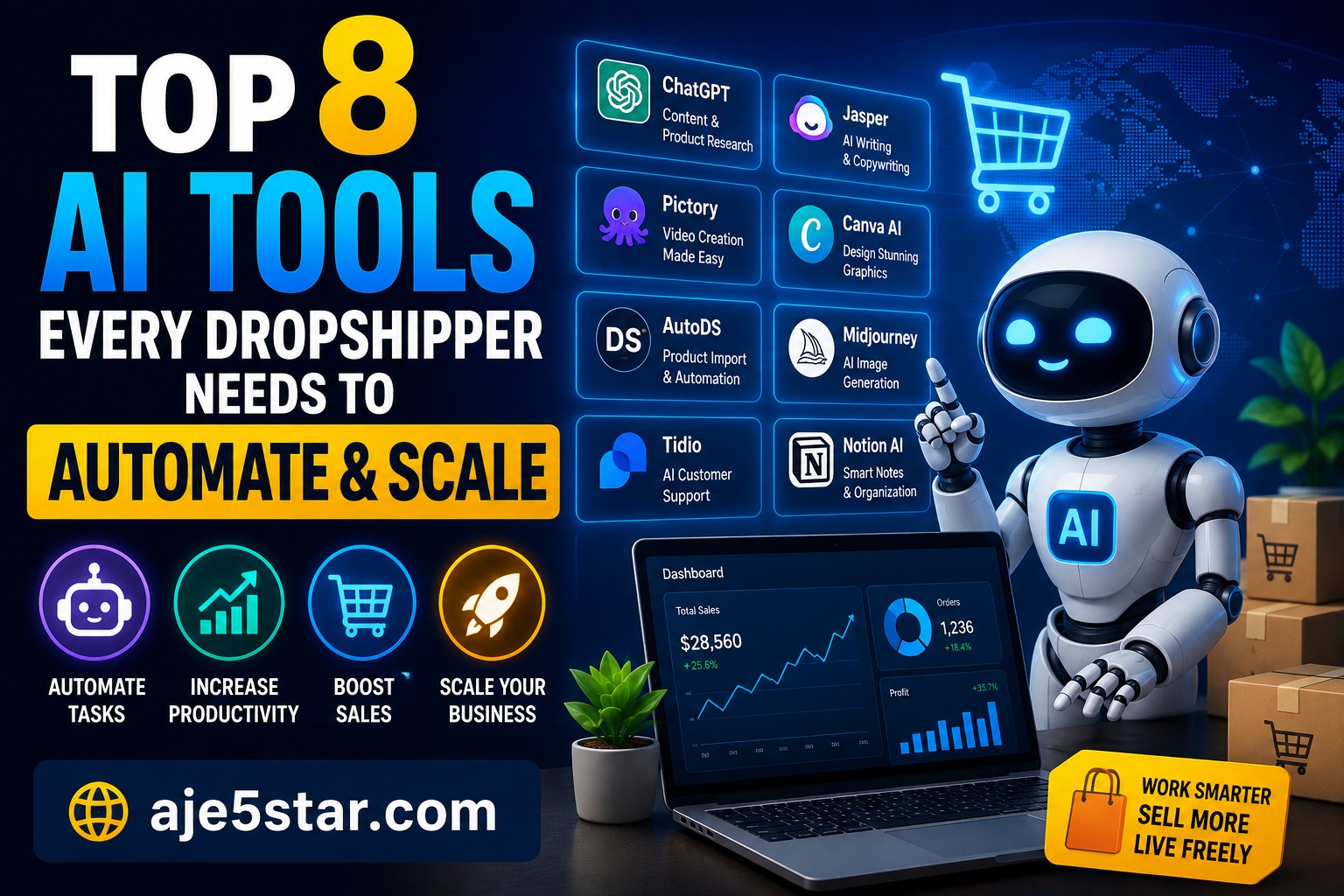
Top 8 AI Tools Every Dropshipper Needs to Automate & Scale
Top 8 AI Tools Every Dropshipper Needs: Automate Tasks, Save Time, and Grow Profits The landscape of e-commerce is rapidly evolving, and running a profitable dropshipping business requires more than just finding a good supplier. To truly achieve financial freedom and scale your operations without burning out, you need to work smart, save time, and scale faster. This is where Artificial Intelligence steps in as your ultimate competitive advantage. Why spend hours manually writing product descriptions, analyzing competitors, or answering basic customer queries when intelligent software can do it for you? By integrating the right artificial intelligence stack into your workflow, you can automate repetitive tasks, boost your sales with better content, and significantly lower your operational costs. Let’s break down the ultimate 8-step tech stack for modern dropshippers. WORK SMART. EARN MORE. Focus on growth, not busywork. These eight tools are designed to automate tasks, improve customer experience, and increase your profit margins. The 8 Must-Have AI Tools for Dropshipping Success 1 ChatGPT Best For: Content Creation & Customer Support ChatGPT remains the foundational tool for any online business owner. It excels at generating highly engaging product descriptions, crafting persuasive ad copy, and writing professional email sequences. Beyond marketing, it can be programmed to handle first-tier customer support inquiries, allowing you to maintain high response rates without being chained to your inbox all day. 2 Copy.ai Best For: Ad Copy & Product Descriptions While general chatbots are great, Copy.ai is specifically trained on high-performing marketing frameworks. If you struggle with the blank page syndrome, this tool will generate high-converting product copy and dynamic Facebook or TikTok ad variations in seconds. It ensures your store speaks directly to the pain points and desires of your target audience. 3 Canva AI Best For: Designs & Branding Visuals sell the product. Canva’s integrated AI features allow you to remove backgrounds, generate unique elements, and create stunning product images and marketing visuals instantly. You don’t need a degree in graphic design to build a cohesive, premium-looking brand identity that builds trust with potential buyers. 4 Pictory AI Best For: Video Ads & Social Content Video is the undisputed king of dropshipping ads, particularly on platforms like TikTok and Instagram Reels. Pictory AI empowers you to turn text scripts or product URLs into engaging, fast-paced video advertisements in minutes. It automatically syncs stock footage or your uploaded clips with text overlays, saving thousands of dollars in video editing fees. 5 Google Gemini Best For: Market Research & Ideas Knowing what to sell is half the battle. Use Google Gemini to process vast amounts of web data, research emerging product trends, and gather deep customer insights. It helps you analyze market shifts and validate your niche ideas before you invest time and budget into building out a product page. 6 ZIK Analytics Best For: Product Research & Competitor Spy Stop guessing what will sell and start using data. ZIK Analytics is an essential tool for finding proven, winning products and analyzing the market. It allows you to “spy” on competitors, track their sales volumes, and identify gaps in the market that your store can aggressively target and capture. 7 AutoDS Best For: Order Automation & Fulfillment Scaling from 10 orders a day to 100 orders a day breaks manual systems. AutoDS automates the entire order fulfillment pipeline. It monitors supplier stock levels, automatically adjusts your pricing based on rules, and processes orders without manual intervention. This is how you transition from running a side hustle to owning an automated digital business. 8 Klaviyo AI Best For: Email Marketing & Retention Acquiring a new customer is expensive; retaining them is pure profit. Klaviyo utilizes predictive AI to send smart, beautifully designed emails at the exact moment a customer is most likely to buy. From abandoned cart recovery sequences to personalized post-purchase follow-ups, it turns one-time buyers into loyal brand advocates. Why AI is Mandatory for Modern Dropshipping The goal of dropshipping is to create passive income potential with low startup costs and no inventory management. However, without automation, you simply end up buying yourself a stressful, low-paying job. Integrating these AI platforms allows you to: Create Professional Content Instantly generate ad copy, video scripts, and product images that rival agency work. Make Data-Driven Decisions Remove the emotion from product selection by relying on competitor analysis and trend data. Improve Customer Experience Provide faster support replies, seamless order tracking, and highly relevant post-purchase communication. Increase Efficiency Automate inventory syncs and fulfillment so you can work from anywhere without being tied to a desk. Publisher’s Note: The tools you use dictate the speed at which you scale. For more strategies on mastering online business and discovering the best tools for your tech stack, visit aje5star.com. Start integrating these systems today, focus on strategy, and watch your profits grow. AI Tools Dropshipping 2026 E-commerce Automation Passive Income Marketing Software aje5star All Posts AI website Book Earn Money Online Education Finance free Movie Habits Investors Marketing movie Sport Tech viral AI prompts Websites You Should Know COMMON TECH MISTAKES(WHAT TO DO AND HOW TO FIX THEM) February 26, 2026/No Comments learn how to identify, fix, and prevent the most common tech mistakes that slow you down and compromise your security…. Read More Free Netflix March 8, 2026/ Free Netflix Movie Warning Tip Don’t download any apk or any file it may contain any malware or virus use… Read More 47+ Legit Ways to Make Money Online (A Beginner’s Guide for 2026) March 11, 2026/ Discover 47+ legitimate, Read More How to Make Money Online in 2025: 28 Proven Ways to Earn From Anywhere March 11, 2026/ Unlock your earning potential with Read More 23 Proven Ways To Make Money Online in 2026 March 11, 2026/No Comments Discover 23 proven strategies to make Read More How to Make Money Online: 25 Ideas for 2026 March 12, 2026/ Discover 25 diverse strategies to Read More 30 Legit Ways to Make Money Online in 2026 March 12, 2026/ Explore 30 legitimate ways

How to Make Money Selling Photos From Your Phone
How to Make Money Selling Photos From Your Phone: The Complete 8-Step Guide The camera resting in your pocket is a powerful financial asset. As digital publishing, digital marketing, and content creation continue to expand at a breakneck pace, the global demand for authentic, high-quality stock imagery has never been higher. Publishers, web developers, and advertisers are constantly sourcing fresh visuals to enhance their digital real estate. You no longer need a professional DSLR setup and thousands of dollars in lenses to enter the stock photography market. Modern smartphones possess advanced sensors capable of producing commercial-grade images. By treating your mobile photography as a systematic digital business, you can generate a sustainable stream of royalties. This comprehensive, eight-step educational guide will walk you through the entire process of transforming your mobile snapshots into a licensed, income-generating portfolio. 1 Focus on Quality Basics Before you can monetize an image, it must meet basic commercial standards. High-megapixel counts alone do not guarantee a sale; the foundation of a profitable photo lies in the photographer’s mastery of the fundamentals. You must actively learn and apply the rules of composition, such as the rule of thirds, leading lines, and framing. Furthermore, mobile sensors thrive in abundant light. Always prioritize natural lighting to avoid the digital noise and grain that often ruin low-light smartphone photos. Publisher’s Action Step: Develop a pre-shoot habit. Always keep your smartphone lens meticulously clean. A single smudge of oil from your fingerprint will cause light flares and softness that immediately disqualify a photo from commercial acceptance, resulting in sharp, attractive photos that buyers want. 2 Choose Your Niche The stock photography market is vast, and generalist portfolios often get lost in the algorithm. To generate consistent sales, you must research high-demand themes and specific subjects that buyers are actively seeking. Consider focusing on evergreen commercial categories. Travel, lifestyle, nature, corporate concepts, and authentic remote-work setups are consistently in high demand. Analyze current trends in digital publishing to understand what modern art directors and bloggers need for their upcoming campaigns. 3 Utilize Easy Editing Apps An image straight out of the camera is rarely a finished product. Post-processing is a critical step in professional photography, and your smartphone is equipped with enough processing power to handle commercial edits. Utilize industry-standard mobile applications like Snapseed or Adobe Lightroom. The goal of mobile editing is to enhance your pictures subtly—correcting white balance, boosting contrast, and lifting shadows to make them pop. Avoid heavy filters; commercial buyers require images that remain authentic and versatile enough to fit their brand’s color palette. 4 Join Stock Photo Agencies Once your images are prepared, you need a marketplace. You must register as a contributor on reputable stock platforms that explicitly accept mobile photography submissions. Major agencies operate as search engines for buyers. Focus your efforts on established industry leaders such as Adobe Stock, Shutterstock, and Getty Images (or iStock). These platforms already have the massive buyer traffic necessary to generate consistent royalty payouts. Read their specific contributor agreements carefully to understand exclusivity clauses and commission rates. 5 Create a Strong Portfolio Stock photography is a numbers game heavily influenced by quality. Uploading a dozen photos and waiting for wealth is not a viable strategy. You must build a diverse and appealing collection. Commit to a schedule where you consistently upload high-quality, relevant content. A strong portfolio often contains hundreds, if not thousands, of tightly curated images. The more varied your portfolio—covering different angles, lighting setups, and subjects within your niche—the higher your probability of appearing in diverse buyer searches. 6 Apply Keywords & Metadata The most beautiful photo in the world will never sell if a buyer cannot find it. Mastering metadata is arguably as important as the photography itself. You must use highly descriptive titles, tags, and keywords to ensure your photos are easily searchable. If you are uploading an image of a beach, do not just tag “beach” and “nature.” Use long-tail descriptors such as “empty tropical beach at sunset,” “white sand clear water,” or “travel destination relaxation.” Think exactly like a web designer typing a query into a search bar. 7 Submit & Get Approved Every reputable agency has a strict quality control process. Human reviewers or AI systems will analyze your submissions for technical flaws, copyright issues, and commercial viability. It is imperative that you understand agency guidelines for resolution and content limits (such as avoiding visible brand logos or securing model releases for recognizable faces). Rejections are a normal part of the process for every contributor. Learn from the rejection reasons, adjust your approach, and be patient during the review cycle. 8 License & Earn Royalties The final step is the realization of your passive income system. Once your images are approved and live in the agency’s database, they are available for global licensing. Ensure you set up your payment options accurately within your contributor dashboard (often via PayPal, Payoneer, or direct bank transfer). You will receive royalties whenever your photos are downloaded. Because these are digital assets, a single photograph can be licensed an infinite number of times, generating income long after the shutter was pressed. Educational Note from aje5star.com: Building a stock photography business requires treating your phone like a professional tool. Pair this visual strategy with strong SEO knowledge, and you’ll understand exactly what digital publishers are looking for when they purchase images for their own content. Mobile Photography Passive Income Stock Agencies Side Hustle 2026 Content Creation aje5star All Posts AI website Book Earn Money Online Education Finance free Movie Habits Investors Marketing movie Sport Tech viral AI prompts Websites You Should Know COMMON TECH MISTAKES(WHAT TO DO AND HOW TO FIX THEM) February 26, 2026/No Comments learn how to identify, fix, and prevent the most common tech mistakes that slow you down and compromise your security…. Read More Free Netflix March 8, 2026/ Free Netflix Movie Warning Tip Don’t download any apk or any file it may contain any malware or virus use… Read More 47+
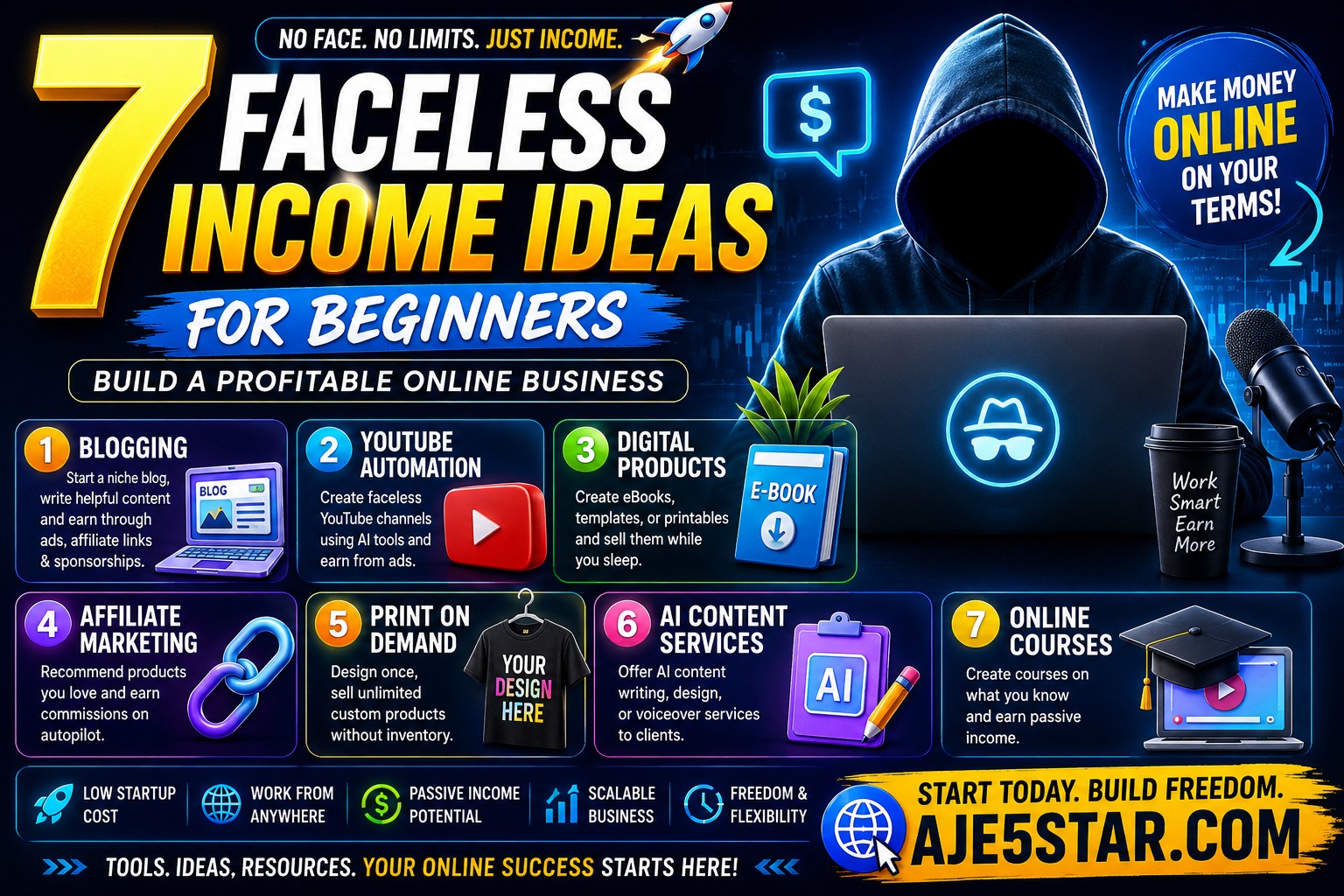
7 Faceless Income Ideas for Beginners: Build a Profitable Online Business
7 Faceless Income Ideas for Beginners: Build a Profitable Online Business The digital economy has entirely rewritten the rules of entrepreneurship. Historically, building a brand meant putting yourself in the spotlight, standing in front of a camera, and tying your personal identity to your business. Today, that is no longer a requirement. If you have been holding back on launching an online venture because you value your privacy or simply have zero desire to be on video, you are in the right place. You do not need to show your face to build a highly profitable, scalable online business. NO FACE. NO LIMITS. JUST INCOME! Work online. Earn anywhere. Live freely. We are going to break down seven proven, step-by-step strategies that require low investment, offer high potential, and allow you to work from anywhere. Let’s dive into the ultimate blueprint for faceless income. 1 Sell Digital Products Selling digital products is one of the most lucrative online business models because it involves creating an asset once and selling it infinitely. There are no shipping costs, no inventory to manage, and no supply chain headaches. How to Execute: Identify a Problem: What information or organizational tool do people in your niche desperately need? Format the Solution: Create ebooks, digital planners, organizational templates, or printables. Build the Product: Use tools like Canva or Google Docs to design professional-grade assets. Host & Automate: Utilize platforms like WooCommerce (perfect for WordPress users), Gumroad, or Etsy to automate the delivery of your product upon purchase. 2 Start a Faceless YouTube Channel YouTube is the second largest search engine in the world, and you do not need to be a vlogger to capitalize on its traffic. “Faceless” channels rely on compelling narratives and strong visuals rather than a human host. How to Execute: Choose a High-CPM Niche: Finance, software tutorials, psychology, and business automation are highly profitable categories. Scripting: Write highly engaging, value-driven scripts (you can utilize AI outlining tools to accelerate this process). Visuals & Audio: Combine high-quality stock footage, screen recordings, and professional AI voiceovers to create your videos. Optimize: Focus heavily on your thumbnail design and SEO-optimized titles to drive click-through rates. 3 Blog & SEO Content Blogging remains one of the most powerful foundations for a faceless online business. By writing helpful, highly-targeted blog posts, you can rank on Google and build a passive traffic machine. How to Execute: Platform Setup: Launch a self-hosted WordPress site (the industry standard for SEO). Keyword Research: Find long-tail questions your target audience is searching for using tools like Ahrefs or Ubersuggest. Publishing: Write comprehensive, step-by-step guides that genuinely solve the searcher’s query. Monetization: Once traffic flows, monetize through premium ad networks (like Mediavine or Raptive) and strategic affiliate marketing. Educational Publisher Tip: When building out your WordPress content strategy, ensure your technical foundation is flawless. Clean HTML, responsive CSS, and fast loading speeds are just as critical to SEO as the words on the page. Learn more about optimizing your digital presence at aje5star.com. 4 Affiliate Marketing Affiliate marketing allows you to promote products you love and earn commissions on every sale you generate. You hold no inventory and handle no customer service—you act strictly as the bridge between the consumer and the solution. How to Execute: Join Networks: Sign up for platforms like ShareASale, Impact, or the Amazon Associates program. Select Products: Only promote high-quality software, courses, or physical products relevant to your audience. Contextual Promotion: Do not just paste links. Write in-depth product reviews, comparison articles (e.g., “Tool A vs. Tool B”), and “How-to” guides that naturally feature your affiliate links. 5 Email Marketing Social media algorithms change daily, but you own your email list. Building an engaged newsletter is one of the most stable ways to generate a faceless income. How to Execute: The Lead Magnet: Offer a free, high-value digital asset (like a cheat sheet or mini-course) in exchange for an email address. The Funnel: Use landing pages to capture leads on autopilot. Nurture Sequences: Set up an automated welcome sequence that provides massive value before ever asking for a sale. Monetize: Send weekly newsletters featuring affiliate promotions, your own digital products, or sponsored placements. 6 Create & Sell Templates Similar to digital products but highly specialized, templates save other business owners and creators time. If you have an eye for design or system organization, this is a massive market. How to Execute: Identify the Platform: Choose where you excel—Canva, Notion, Excel, or even WordPress Elementor kits. Build Kits: Create cohesive social media kits, media pitch templates, or comprehensive business management dashboards in Notion. Market the Utility: When selling, don’t sell the “design.” Sell the hours of time your template will save the buyer. 7 AI Voice Services The rise of artificial intelligence has created entirely new service categories. If you know how to operate advanced AI voice software, you can act as an agency or freelancer providing audio content. How to Execute: Master the Tech: Become proficient in platforms that generate ultra-realistic AI voiceovers and narrations. Build a Portfolio: Create samples of audiobook narrations, commercial voiceovers, and YouTube video narrations. Offer the Service: List your services on B2B marketplaces, Upwork, or directly pitch content creators who need affordable, fast-turnaround audio for their videos. The Bottom Line: Be Your Own Boss The barrier to entry for building a digital business has never been lower. Whether you choose to sell Notion templates, launch an SEO-driven WordPress blog, or build an automated faceless YouTube channel, the principles remain the same: Low Investment, High Potential, and the ability to Work from Anywhere. You don’t need a camera to build your dream life. You just need a strategy, consistency, and the willingness to start today. Pick one of the seven methods above, commit to it for six months, and watch your online income grow. Digital Products Faceless YouTube SEO & Blogging Affiliate Marketing Email Marketing Online Business 2026 aje5star All Posts AI website Book Earn Money Online Education Finance free Movie Habits Investors
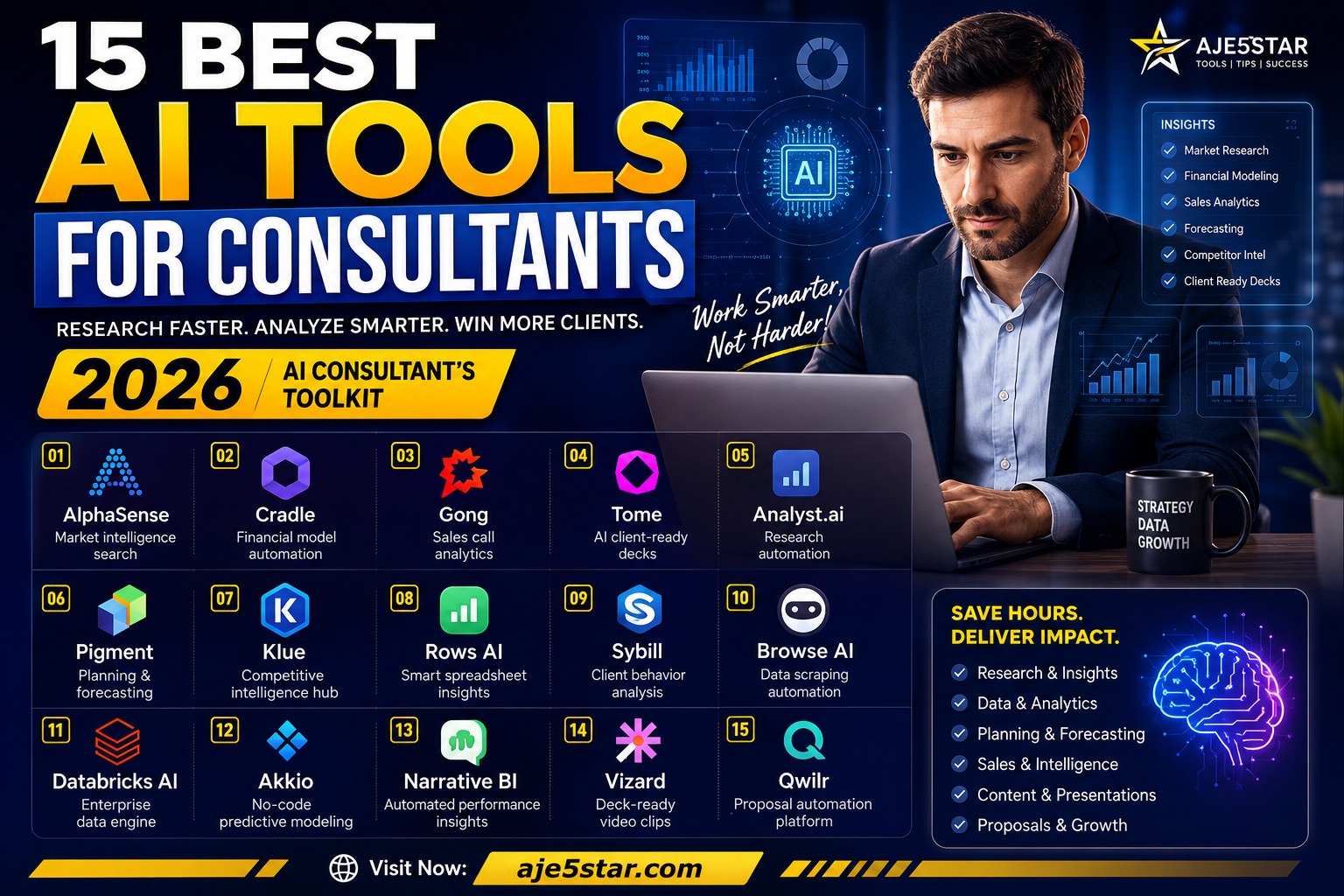
Best ai tools for consultants
15 AI TOOLS FOR CONSULTANTS Research Faster. Analyze Smarter. Win More Clients. AI Consultant’s Toolkit aje5star.com Artificial intelligence is changing consulting faster than many firms expected. Consultants have traditionally spent a significant amount of time researching markets, analyzing spreadsheets, preparing presentations, monitoring competitors, reviewing customer conversations, building forecasts, creating proposals, and turning raw information into client-ready recommendations. Today, many of those tasks can be accelerated with AI. The important point, however, is that AI does not replace the consultant’s judgment. Instead, the best AI tools can reduce repetitive work and give consultants more time to think strategically, communicate with clients, test assumptions, and solve complex business problems. The tools highlighted below range from market intelligence and financial modeling to sales analytics, competitive intelligence, predictive modeling, video creation, and proposal automation. We’ve analyzed the tools and their potential consulting use cases. Editor’s note: The list below should be treated as a discovery list rather than a definitive ranking. Some products have evolved considerably, and capabilities can change quickly. Always evaluate current features, pricing, security, and data-handling policies before using an AI platform with confidential client information. Why AI Tools Matter for Consultants Consulting is fundamentally an information business. A consultant may need to answer questions such as: What is happening in this market? Who are the major competitors? How is customer behavior changing? What is driving revenue? What could happen under different financial scenarios? What does the client’s sales pipeline look like? What are customers saying? How should the findings be presented to executives? How can a proposal be produced faster? Which data deserves deeper investigation? Historically, answering these questions could involve dozens of browser tabs, spreadsheets, research reports, interviews, CRM exports, and PowerPoint slides. AI-enabled platforms can bring parts of that workflow together. For example, AlphaSense positions itself as a market intelligence platform combining search, research content, AI summarization, and monitoring capabilities. Similarly, Gong analyzes customer interactions to help revenue teams understand deals, customer relationships, and sales performance. This creates an important opportunity for consultants: Spend less time collecting information and more time interpreting it. 1. AlphaSense — Market Intelligence and Research AlphaSense is one of the strongest tools on this list for consultants involved in market research, strategy, investment research, and competitive analysis. The platform combines large collections of business information with AI-powered search and summarization. For consultants, that can be particularly useful when a project requires research across a large number of documents. Potential consulting use cases: Market research & Industry analysis Competitor & Company research Investment research Customer and market trend analysis Earnings-call analysis Best for: Strategy consultants, investment consultants, corporate strategy teams, and market researchers. 2. Cradle — Financial Modeling Automation Editorial note: Searches for the name produce multiple unrelated products and companies, so publishers should verify the exact Cradle product intended before attaching a specific official URL. Financial modeling remains one of the most time-consuming analytical tasks in consulting. AI can potentially help automate parts of building revenue forecasts, cost models, profit-and-loss projections, cash-flow models, scenario analyses, and valuation models. Best practice: Use AI to accelerate model construction, data gathering, and repetitive calculations, but have an experienced financial professional validate assumptions, formulas, and historical figures. A model can be beautifully formatted and still be wrong. Best for: Financial consultants, investment professionals, FP&A teams, and analysts. 3. Gong — Sales Analytics and Revenue Intelligence Gong is particularly interesting for consultants working with sales organizations. Its revenue intelligence platform analyzes customer interactions and surfaces insights around deals, pipeline, buyer relationships, and sales performance. Instead of relying only on interviews with sales managers, consultants can analyze a much broader body of customer interactions and compare what people say is happening with what is actually happening in sales conversations. That can make recommendations more evidence-based. Best for: Sales consultants, revenue operations consultants, and go-to-market strategy teams. 4. Tome — AI-Powered Client Presentations Consultants spend enormous amounts of time creating presentations. Tome is designed to use AI to help create presentations and other visual documents from prompts. The strongest workflow is: AI draft → consultant analysis → fact checking → visual refinement → client-ready presentation. A professional consultant should treat AI-generated slides as a first draft, not the final deliverable. Best for: Management consultants, strategy consultants, and business development teams. 5. Analyst.ai — Research and Data Analysis Analyst.ai is an AI-powered data analysis platform where users upload data and receive automated analysis, insights, and visualizations. Consultants frequently receive Excel spreadsheets, CSV files, survey results, and operational metrics. AI data-analysis tools can help identify trends, outliers, relationships, and performance changes. However, never assume that an AI-generated conclusion is automatically correct. Best for: Data-heavy consulting projects and analysts. 6. Pigment — Planning and Forecasting Pigment is a strong choice for consultants working on financial planning, business planning, budgeting, and forecasting. One particularly useful concept is scenario modeling. Instead of asking only “What will happen?” consultants can ask “What happens if revenue grows 5% instead of 10%?” That turns forecasting into a strategic decision-making exercise. Best for: FP&A consultants, strategy consultants, and finance transformation teams. 7. Klue — Competitive Intelligence Competitive intelligence is another area where AI can save consultants significant research time. Klue helps organizations collect, curate, and distribute competitive information. Imagine a consultant preparing a market-entry strategy. They may need to understand who the competitors are, what they charge, and how their messaging has changed. Competitive intelligence software makes that monitoring process systematic. Best for: Strategy consulting, sales strategy, product strategy, and market-entry projects. 8. Rows AI — Intelligent Spreadsheet Analysis Spreadsheets are still everywhere in consulting. Rows attempts to combine spreadsheet functionality with AI-assisted analysis, including formula creation, chart generation, data cleaning, and forecasting. Instead of manually writing several formulas, you might ask: “Identify the three regions with the fastest revenue growth and create a chart.” The objective isn’t to eliminate spreadsheet skills; it is to reduce repetitive spreadsheet work. Best for: Business analysts, consultants, and teams that live in spreadsheets. 9. Sybill — Client and Buyer Intelligence Sybill
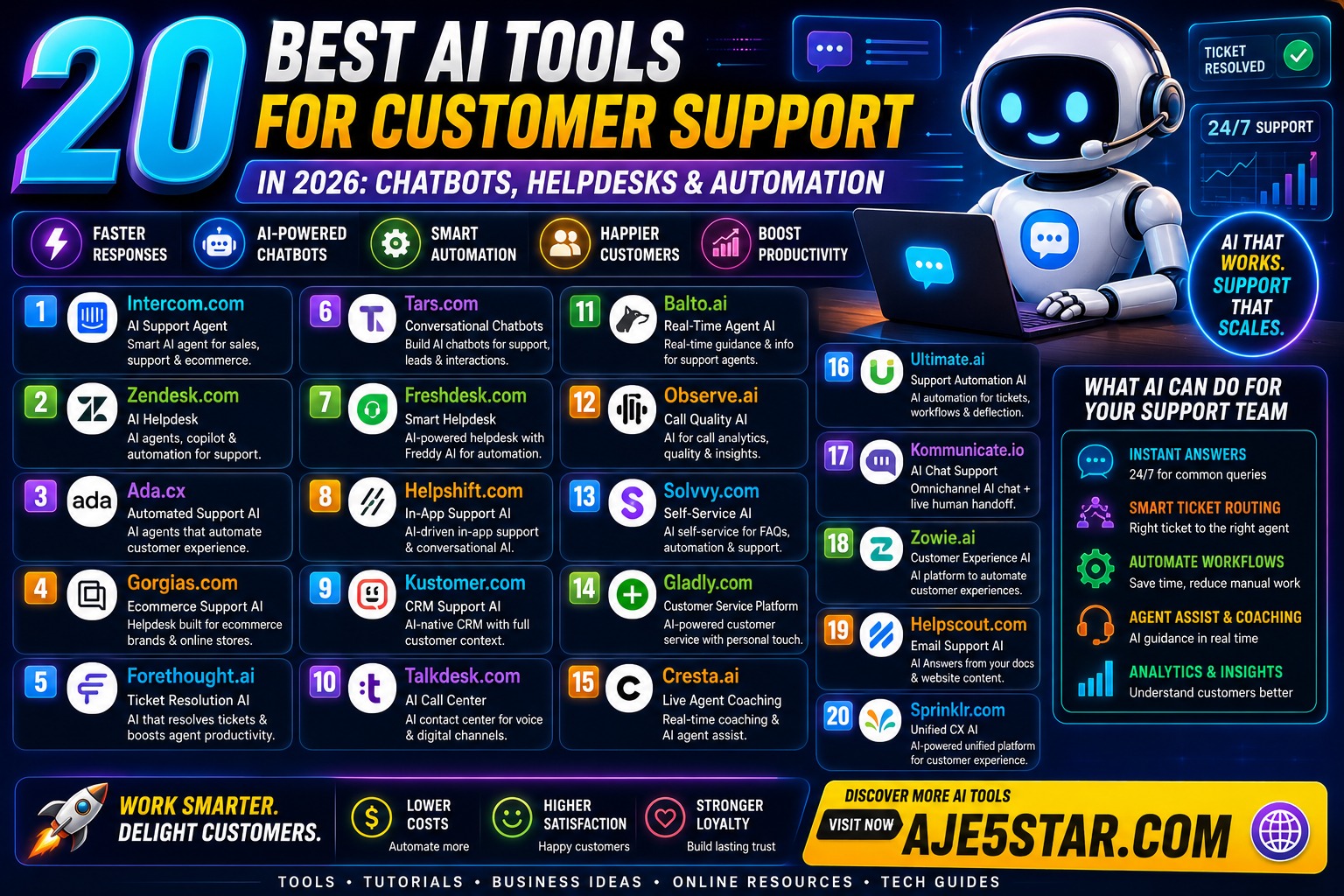
20 Best AI Tools for Customer Support: Chatbots, Helpdesks & Automation
20 Best AI Tools for Customer Support in 2026 🌙 Dark Mode 20 Best AI Tools for Customer Support in 2026: AI Chatbots, Helpdesks & Customer Service Automation Customer expectations have changed dramatically. People no longer want to wait hours or sometimes days for a simple answer to a question. They want to know: Where is my order? How do I reset my password? Can I change my subscription? How do I return this product? Why was I charged? How do I use this feature? Can someone help me right now? For businesses, answering these questions manually can become expensive and time-consuming. That’s where AI customer support tools come in. This updated guide explains what each platform is known for and highlights important changes readers should know about. 📑 Table of Contents ▼ What Are AI Customer Support Tools? Why Businesses Are Using Customer-Service AI 20 AI Support Tools Breakdown How to Choose an AI Support Tool How AI Changes a Customer Support Team AI Customer Support Best Practices What Should You Automate First? What Should You Be Careful Automating? How to Evaluate an AI Tool Publisher’s Update & Final Thoughts What Are AI Customer Support Tools? AI customer support software uses artificial intelligence to help businesses communicate with customers, organize support requests, answer questions, and assist human agents. Depending on the platform, AI can help with: Live chat & Email support Ticket classification & Routing Automated answers & Knowledge-base search Customer self-service & Call-center assistance Agent coaching & Conversation summaries Sentiment analysis & Customer data analysis The technology is moving beyond the traditional chatbot. Older chatbots often worked like this: Customer asks → bot searches predetermined answer → bot responds. Modern AI agents can potentially understand context, search knowledge sources, perform authorized actions, and escalate complicated situations to human representatives. Real-World Example: Customer: “My order arrived damaged. Can I get a replacement?” A modern support system might identify the intent, access the customer’s order information, explain the replacement policy, create or update a case, and escalate the conversation if a human needs to approve the request. That is a much more sophisticated workflow than simply displaying an FAQ. Why Businesses Are Turning to AI Customer Support 1. Customers want faster answers A customer usually doesn’t care how complicated a company’s internal support structure is. They simply want their problem solved. AI can provide immediate responses to common questions. 2. Support teams receive repetitive questions Many companies discover that a surprisingly large percentage of their support conversations revolve around the same topics: password resets, shipping information, returns, refunds, billing questions, account settings, and product instructions. Automating repetitive requests gives human agents more time to focus on complicated problems. 3. AI can assist human agents AI doesn’t have to communicate directly with customers. It can work behind the scenes. For example, an agent receives a complicated support ticket. AI can read the conversation, summarize the customer’s problem, search the knowledge base, suggest an answer, and draft the response for agent review. 20 AI Tools for Customer Support in 2026 1. Intercom AI Agent & Copilot Intercom is one of the most recognizable names in modern customer support software. Its AI agent, Fin, has evolved significantly beyond a simple chatbot into a customer-facing AI agent that can operate across service, sales, and ecommerce roles. Intercom also provides Copilot, which is designed to assist human support representatives directly. 2. Zendesk AI Helpdesk Zendesk is a giant in helpdesk software. Its AI offering has expanded considerably to include AI agents, agent assistance, generative search, ticket summaries, suggested macros, intelligent triage, translation, and automated customer interactions across messaging, email, and web forms. 3. Ada Agentic CX Ada focuses heavily on AI-powered customer experience. The company positions its platform around agentic customer experience, emphasizing AI agents capable of resolving customer needs while handing conversations to human agents when necessary. 4. Gorgias Ecommerce Support Gorgias combines helpdesk functionality with AI and ecommerce integrations (such as Shopify). It is designed specifically for online stores to handle order tracking, return policies, product recommendations, and shipping options. 5. Forethought Multi-Agent Workflow Forethought approaches customer support as an end-to-end workflow across Chat, Email, Voice, and Slack. It helps with classification, resolution, escalation, and deep conversation analysis. 6. Tars Conversational AI Tars specializes in conversational experiences and chatbot technology for lead generation, customer support, FAQs, qualification, and appointment workflows. 7. Freshdesk Freddy AI Part of the Freshworks ecosystem, Freshdesk offers Freddy AI, featuring AI Copilot, AI Agent Studio, writing assistance, ticket summaries, and complete support automation. 8. Help Scout AI Answers Help Scout makes support conversational and manageable. Its AI Answers feature uses a company’s website and knowledge-base content to provide instant, accurate responses through its Beacon widget. 9. Kustomer Context-Aware CX Kustomer treats every interaction through a comprehensive customer record (purchase history, previous conversations, loyalty status) rather than isolated tickets. 10. Talkdesk AI Contact Center Relevant to contact centers handling high volumes of phone calls, Talkdesk provides AI agents, voice self-service, knowledge tools, and call automation. 11. Balto Real-Time Coaching Balto focuses on live guidance. Its Real-Time Agent Assist surfaces knowledge base information and CRM data live during phone conversations while agents speak with customers. 12. Observe.AI Contact Center Analytics Observe.AI provides voice AI agents, real-time guidance, post-interaction summaries, and deep analytics to evaluate customer satisfaction and agent process compliance. 13. Solvvy Self-Service AI Solvvy was known for AI-powered customer self-service and conversational support. Publisher’s note: Always verify corporate/acquisition status when citing legacy lists. 14. Gladly Customer-Centered CX Gladly treats customer service as a single continuous conversation across lifetime touchpoints rather than disconnected tickets. 15. Cresta Live Agent Assist Cresta focuses on real-time guidance during customer interactions, surfacing source-backed answers, identifying important moments, and suggesting responses while keeping the representative in control. 16. Ultimate.ai Now Zendesk Originally listed as an independent support-automation tool, Zendesk acquired Ultimate in 2024. Its technology is now incorporated directly into Zendesk’s AI agent ecosystem. 17. Kommunicate AI + Human Hybrid Kommunicate combines AI automation with
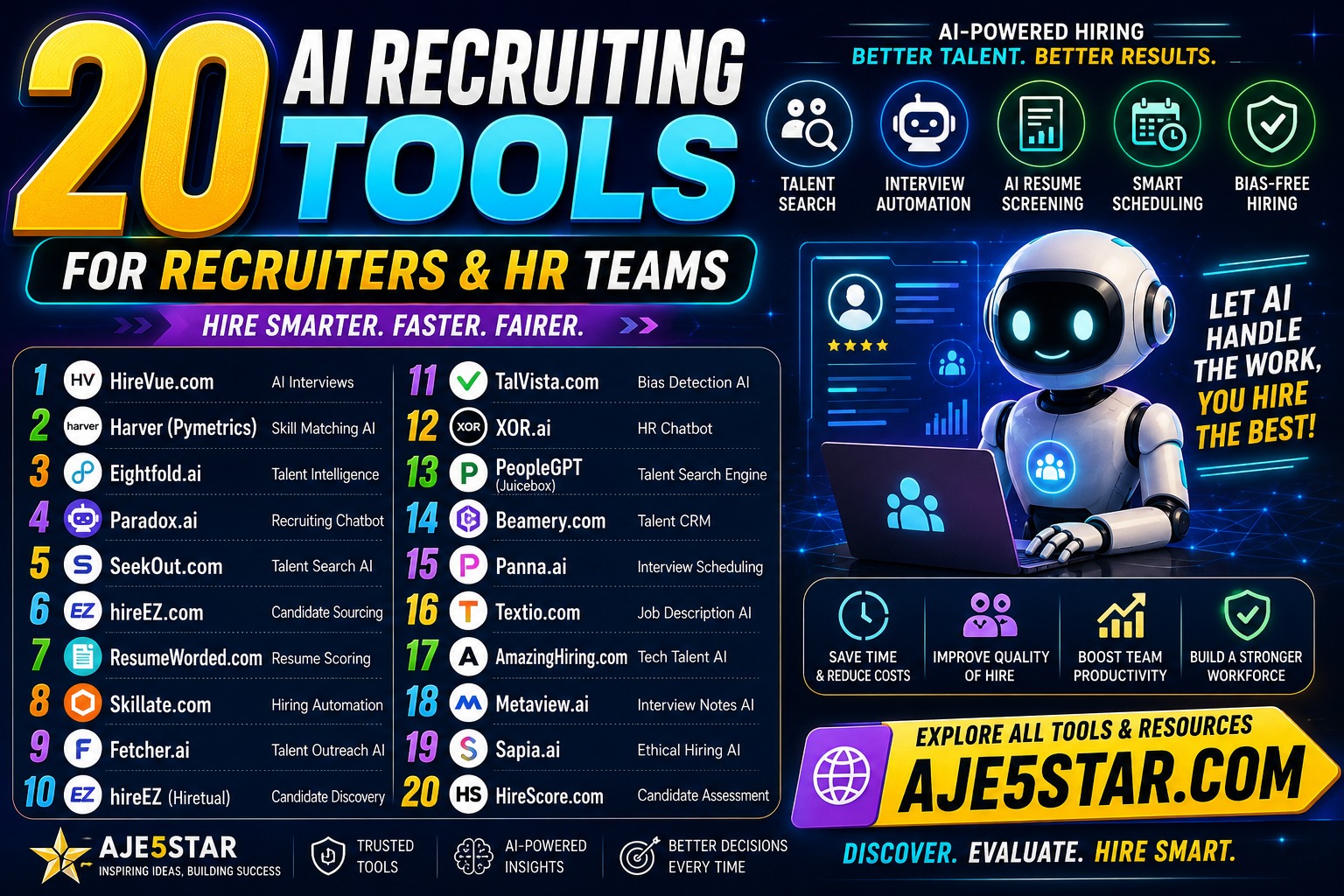
20 ai recruiting too ls for recruiters HR Teams
20 Best AI Recruiting Tools for Recruiters & HR Teams 20 AI TOOLS FOR RECRUITERS & HR TEAMS AI HIRING • TALENT SEARCH • INTERVIEWS • AUTOMATION • ASSESSMENTS 20 AI Tools for Recruiters & HR Teams in 2026: The Best AI Recruiting Software to Know Artificial intelligence is becoming an increasingly important part of modern recruiting. Today, recruiters are navigating massive candidate pools, increasingly complex skills requirements, distributed remote hiring, repetitive administrative tasks, interview scheduling, constant candidate follow-ups, resume screening, and the high-stakes race to find qualified talent before competitors do. That is precisely where AI recruiting software can assist. The infographic accompanying this topic highlights 20 tools and platforms associated with key stages of the talent acquisition pipeline—from candidate sourcing and talent intelligence to automated interviews, assessments, conversational chatbots, job-description optimization, and automated interview notes. However, as a serious publisher, we shouldn’t simply re-share a viral list without thorough verification. AI tech moves fast! Several platforms from older lists have rebranded, merged, or been acquired over recent years. For instance, pymetrics was acquired by Harver, while Hiretual rebranded as hireEZ. So, this guide does two essential things: Explains exactly what each tool or category is best used for today. Points you directly toward the current official company or product identity for 2026. ⚠️ Essential Principle: AI as Support, Not Replacement Important: AI hiring tools are designed to support qualified human decision-making, not blindly replace it. Employers must evaluate accuracy, privacy, accessibility, explainability, discrimination risks, security, and local employment laws before deploying AI within their hiring process. Table of Contents Collapse [−] Why Are Recruiters Using AI? 1. HireVue 2. Harver / pymetrics 3. Eightfold AI 4. Paradox 5. SeekOut 6. hireEZ 7. Resume Worded 8. Skillate 9. Fetcher 10. hireEZ (formerly Hiretual) 11. TalVista 12. XOR AI 13. PeopleGPT / Juicebox 14. Beamery 15. Panna Recruit 16. Textio 17. AmazingHiring 18. Metaview 19. Sapia.ai 20. HireScore How to Choose AI Software The Biggest Risks of AI Recruiting A Practical AI Recruiting Stack Final Thoughts Why Are Recruiters Using AI? Recruiting has traditionally involved an overwhelming amount of repetitive, operational work. On any given day, a recruiter may need to: Search through hundreds or thousands of candidate profiles. Review voluminous piles of resumes. Compare candidate profiles against complex job specs. Perform cold outreach to passive talent. Answer repetitive candidate questions. Manage endless back-and-forth interview scheduling. Take detailed notes during live interviews. Draft and refine inclusive job descriptions. Maintain clean ATS candidate databases. Coordinate feedback with internal hiring managers. Track candidate movement across hiring pipelines. AI tools streamline many of these exact pain points. However, the crucial distinction lies between automation and decision-making. An AI system excels at organizing raw data, surfacing overlooked profiles, summarizing meeting notes, or arranging calendar slots. But that does not mean an algorithm should make the ultimate decision to hire or reject someone. That distinction is paramount when human careers and livelihoods are at stake. Top 20 AI Tools for Recruiters & HR Teams in 2026 1. HireVue — AI Interviews & Hiring Assessments 01 HireVue is one of the most established names in AI-driven talent assessment. Its platform features AI-assisted video interviewing capabilities designed to help large organizations evaluate candidates efficiently at scale. HireVue’s AI Interviewer acts as part of a structured workflow to surface core skills early in the funnel. What recruiters use it for: Candidate screening, skills assessments, structured interview workflows, and managing high-volume hiring drives. Why it matters: When a position attracts thousands of applications, manual screening conversations are impractical. HireVue helps gather initial structured signals so recruiters can spend high-touch time with later-stage candidates. 2. Harver / pymetrics — Behavioral & Talent Assessments 02 While older graphics list pymetrics.ai as a standalone tool, Harver acquired pymetrics in 2022, integrating its behavioral assessment technology into Harver’s broader talent-decision ecosystem. What it’s known for: Cognitive and behavioral games designed to reveal candidate soft skills, potential, and trait compatibility beyond what a flat resume shows. Key takeaway: Resumes reveal past experience; behavioral assessments aim to measure inherent potential. However, employers must continuously audit assessment tools to prevent algorithmic bias or demographic disparities. 3. Eightfold AI — Talent Intelligence 03 Eightfold AI centers on deep Talent Intelligence, using deep learning to match candidates based on holistic skills rather than rigid job titles. Potential use cases: Skill-based candidate matching, talent pool search, supporting internal mobility, high-volume sourcing, and workforce planning. Why it matters: Modern recruiting is shifting away from matching exact historical titles. Eightfold looks at “What can this person actually do and learn?” rather than just “What was their last title?” 4. Paradox — Recruiting Chatbots & Conversational AI 04 Paradox is best known for its conversational assistant (historically known as Olivia). It simplifies candidate interactions via conversational SMS or web interfaces. Candidate: “I want to apply for the warehouse position.” Paradox AI: “Great! I can help you get started. Do you have experience working in a warehouse environment?” 2026 Market Update: Following Workday’s agreement to acquire Paradox, its conversational layer is becoming even more deeply tied into enterprise HR ecosystems. 5. SeekOut — AI Talent Search 05 SeekOut provides recruiters with advanced multi-channel candidate discovery across deep web talent pools, technical repos, and internal database records. Best for: Technical recruiting, candidate rediscovery, Diversity, Equity & Inclusion (DEI) sourcing initiatives, and talent market research. Why it stands out: Allows recruiters to search using contextual natural language criteria (e.g., “Python developer with cloud experience in fast-growth tech startups”) instead of clunky, rigid Boolean operators. 6. hireEZ — AI Candidate Sourcing 06 hireEZ utilizes agentic AI capabilities to search across the open web, social channels, and existing Applicant Tracking Systems (ATS) to build targeted, outbound talent pipelines. Key benefits: Proactive candidate discovery, automated contact information enrichment, candidate matching, and automated email drip campaigns. 7. Resume Worded — Resume & LinkedIn Analysis 07 While oriented primarily toward job seekers, Resume Worded provides deep insight into how AI-driven applicant scoring and keyword extraction function in practice. Why